

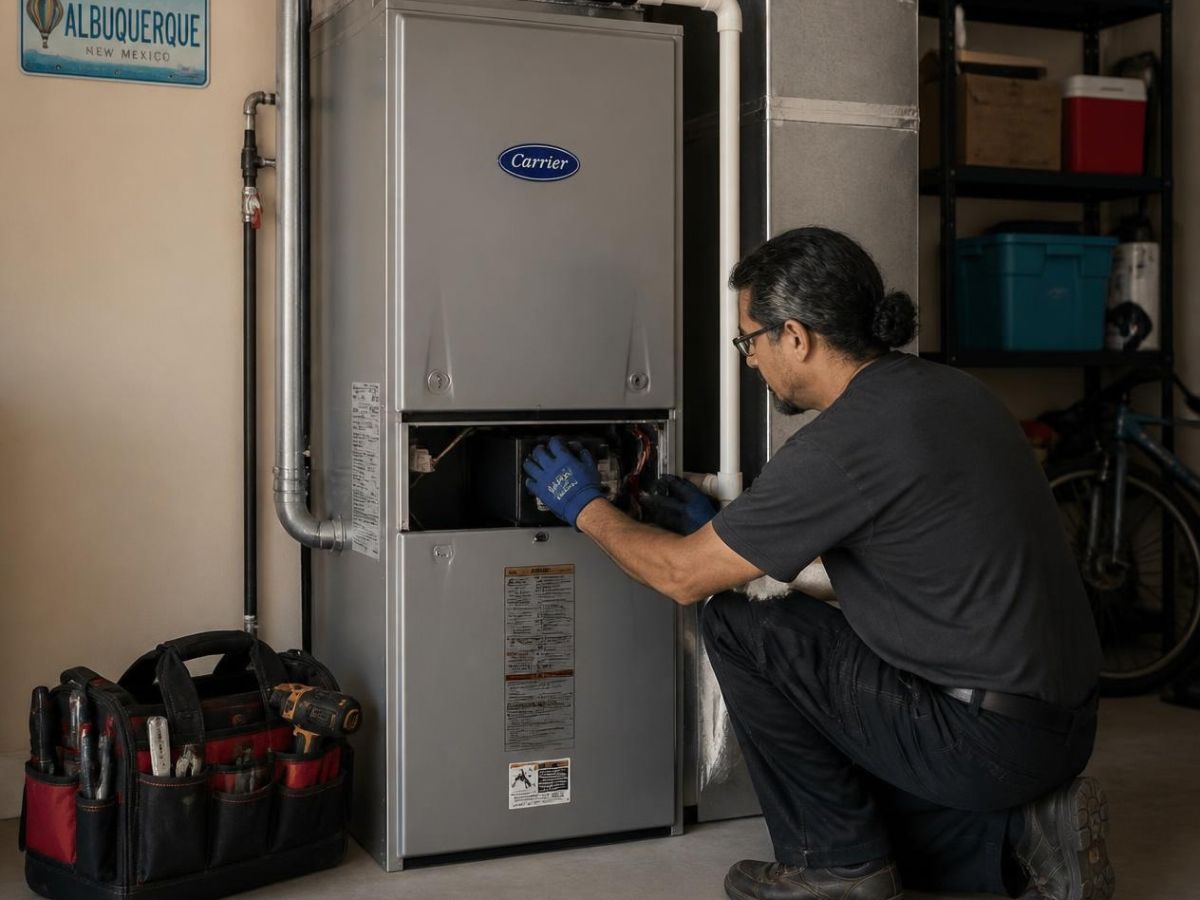
If your Albuquerque furnace is running but only pushing cold air, the most common causes are a clogged filter, a thermostat set to the wrong mode, a furnace that has locked itself out on a safety switch, or a problem with the ignition or gas supply. On a January night here, when lows routinely dip into the mid-20s, a heater blowing cold air is not something to wait out.
Albuquerque winters are milder than most, but they are still cold enough at night to matter. In January the temperature drops about 20 degrees from the afternoon high to the overnight low, so a furnace that quits after dark leaves a house dropping fast toward freezing.
Cold air from a running furnace usually points to one of two situations. Either the blower is moving air while the burners are not firing, or the burners fired briefly and then shut down on a safety control while the fan kept running to cool things off. A dirty filter is behind a surprising number of these calls, because restricted airflow makes the heat exchanger overheat and trip the high-limit switch, which cuts the burners but leaves the blower going. Other times the thermostat got bumped to “cool” or the fan setting sits on “on” instead of “auto,” so the blower runs nonstop and moves room-temperature air even when there is no call for heat.
Our dry, dusty air is part of the local picture. Albuquerque sits at about 5,300 feet with very low humidity, and all that fine dust and pollen loads up a furnace filter faster than people expect. A filter that looked fine in October can be choking airflow by December, so filter checks matter more here than the once-a-season habit many homeowners fall into.
Should I turn my furnace off if it’s blowing cold air?
Yes, but how you do it depends on what you notice. If you smell gas, do not touch the thermostat, light switches, or the furnace. Get everyone out of the house right away, then call New Mexico Gas Company at 1-888-664-2726 or 911 from outside. Do not try to find or fix the leak, and do not go back in until the gas company says it is safe. If there is no gas smell but you suspect an ignition problem, turn the furnace off at the thermostat and call for service.
If there is no gas smell and no burning odor, it is fine to leave the system off while you do a couple of simple checks. Look at the thermostat and confirm it is set to “heat” and the fan is on “auto.” Swap the batteries if the screen is dim. Then pull the filter and hold it up to the light. If you cannot see through it, that is very likely your problem, and a fresh filter may bring the heat right back. Keep in mind that a furnace shutting down on its own is often protecting itself from overheating, so forcing it to keep running rarely helps. If the simple checks do not fix it, leave it off and get a technician out for furnace repair rather than letting it cycle.
How do I reset a furnace heater?
To reset a furnace, turn it off at the thermostat, then cut power at the dedicated furnace switch (it looks like a light switch, usually on or near the unit) or at the breaker. Wait about a minute, restore power, and set the thermostat back to heat a few degrees above room temperature. That full power cycle clears many one-time faults and lets the control board start fresh.
If the furnace fires up and then locks out again, stop resetting it. A furnace that keeps shutting itself down is doing exactly what its safety controls are designed to do, and repeatedly forcing a restart pushes past that protection. Each lockout is the system telling you something is wrong, whether that is airflow, a flame-sensing issue, a pressure switch, or ignition. Cycling it over and over can turn a small, cheap repair into a bigger one.
- Reset once. If it holds and heats normally, watch it for a day.
- If it locks out a second time, leave it off and book service.
- If you smell gas, leave the house and call from outside. If the unit will not ignite at all, keep it off and call.
When a reset only buys you a few minutes of heat, that is your cue to bring in a technician instead of chasing it.
How hot should the air coming out of my furnace be?
Air from the supply vents of a working gas furnace usually lands somewhere around 105 to 140 degrees Fahrenheit, though the exact number depends on your furnace, your ductwork, and how cold the return air is. A properly running heating system should feel clearly warm to your hand at the register, not just faintly heated.
What technicians actually measure is temperature rise, the difference between the cooler return air the furnace pulls in and the warmer supply air it sends out. Every furnace has a data plate listing an acceptable rise, commonly a 30-degree window such as 40 to 70 degrees. We aim for the middle of that range. If the rise runs too high, airflow is usually restricted, and a dirty filter or closed vents are the first suspects. If the air feels only lukewarm coming out of the vents, that points toward weak heat production or an airflow problem worth checking.
Is it normal for my furnace to blow cold air when it first turns on?
Yes. A short burst of cool air at the very start of a heating cycle is normal on many furnaces. The burners fire first, and the blower waits a short time so the heat exchanger can warm up before the fan kicks on. On some systems that delay is brief enough that you feel a little cool air for a few seconds, especially through vents far from the unit where the duct has cooled between cycles.
The difference between normal and a problem is how long it lasts. A few seconds of cool air that turns warm is fine. If the air stays cold for several minutes, never warms up, or the furnace runs and runs without the house reaching the thermostat setting, that is not the startup delay, and it is worth having looked at. In our climate that gap shows up fast once the sun goes down, because a furnace that never delivers real heat cannot keep up with the overnight drop. Persistent cold air, short cycling, or a system that struggles to hit its setpoint all point to something a technician should diagnose.
When your heater is running but the house keeps getting colder on a freezing Albuquerque night, the cause is worth pinning down rather than guessing at. Tru Mechanical Heating & Cooling is a family-owned team with 30-plus years of combined experience and an in-house sheet metal shop for anything duct-related, so we can sort out whether it is a filter, a safety lockout, or something deeper. Contact us for a free quote or a service visit, or call (505) 328-0743 and we will get your heat back on.