

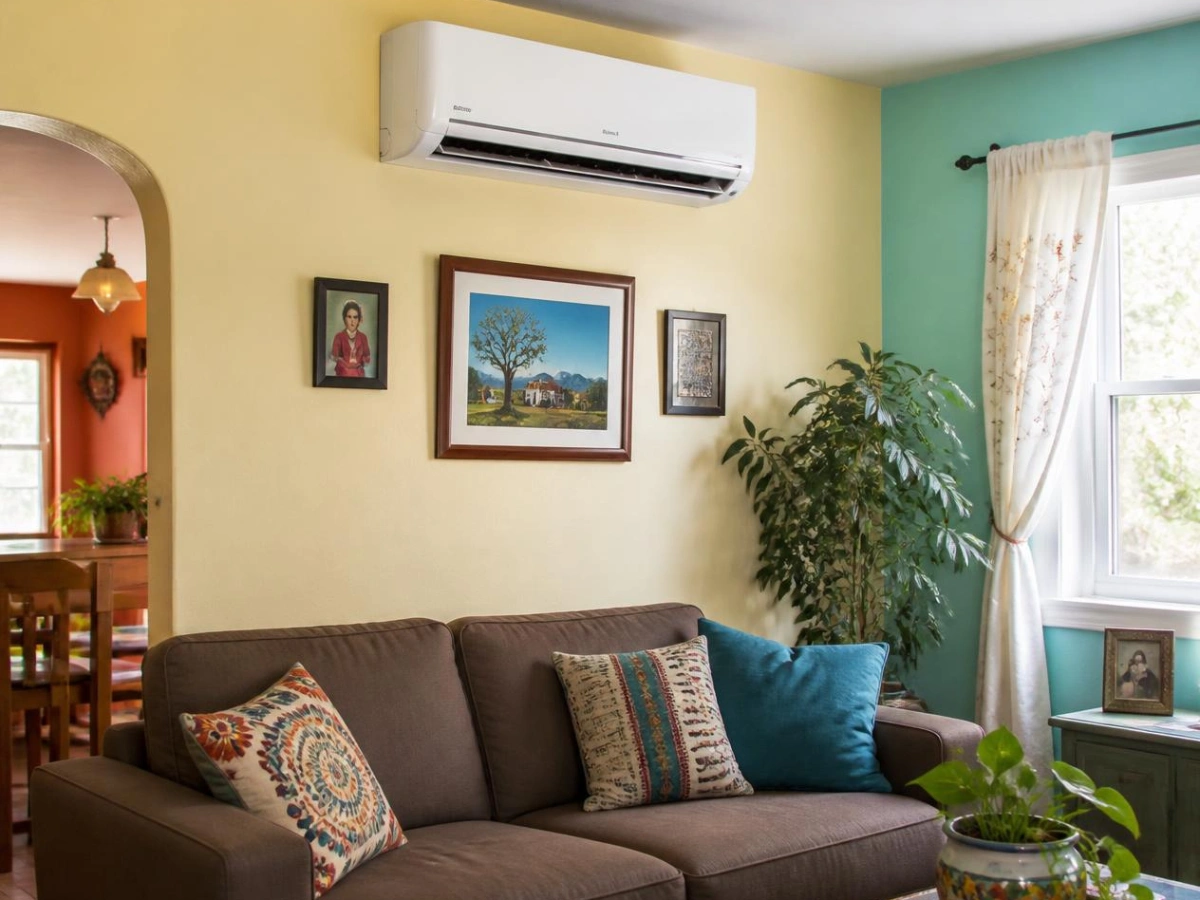
Neither one wins for every Albuquerque home, and the deciding factor usually comes down to your ductwork. If your home already has good duct runs feeding an existing swamp cooler or furnace, a conversion to refrigerated air often makes sense, while a home with no usable ducts is frequently a better fit for a ductless mini-split. Either way the ductwork question drives both the equipment choice and the cost, so it is worth settling before anything else.
A lot of Albuquerque homes still run evaporative coolers, and those coolers hold up fine through the dry spring and early summer. The trouble shows up during monsoon season. When July humidity climbs, a swamp cooler loses its edge and can barely take the edge off a hot afternoon.
That seasonal shift is why so many local homeowners start weighing their options. Both a mini-split and a refrigerated air conversion give you real cooling that does not care how humid it gets outside, and both give you filtered air instead of the raw outside air a swamp cooler pulls in. The right pick depends on how your house is built, what equipment you already have, how many rooms you need to cover, and your budget. Because Tru Mechanical installs both, we can walk you through the trade-offs honestly instead of pushing you toward the one that happens to be easier for us.
Albuquerque sits at about 5,300 feet in a high-desert climate. New Mexico’s adopted energy code places Albuquerque and Bernalillo County in climate zone 4B, a Mixed-Dry classification that the Department of Energy defines by its hot, dry summers and cool winters. Summer afternoons regularly reach the low 90s while winter nights drop into the teens and low 20s. That means whatever you install has to earn its keep in both seasons, and it also means air-source equipment loses a little capacity at our altitude, so proper sizing matters more here than it does closer to sea level.
What are the disadvantages of a ductless mini split?
Mini-splits do a lot of things well, but they are not a perfect match for every home, and it is worth knowing the downsides before you commit. The main ones are visual, structural, and financial.
- The indoor units are visible. Each zone needs a wall-mounted or ceiling head, and some homeowners do not love the look of a unit mounted high on the living room wall.
- Whole-home coverage adds up. A single-zone system is affordable, but covering a larger home means multiple indoor heads, and multi-zone systems in Albuquerque commonly land in the range of about $4,500 to $9,000 or more depending on how many rooms you need.
- They need regular attention. Filters on each head have to be cleaned, and the outdoor unit and refrigerant lines still need service to keep efficiency up.
- Sizing at our altitude is unforgiving. An undersized or wrong-model system struggles on the coldest and hottest days, which is why the load calculation matters.
None of these are dealbreakers for most homes, but they explain why a mini-split is not automatically the answer. If you want the details on how a ductless system would lay out in your specific rooms, that is a conversation worth having before you decide.
Do you need ductwork for either option?
This is the real fork in the road between the two options, and the answer is different for each.
A ductless mini-split needs no ductwork at all. That is the whole point of the design. An outdoor unit connects to one or more indoor heads through a small refrigerant line set that runs through a three-inch hole in the wall, so there is nothing to tear open and no ducts to add. That makes it a strong fit for the thousands of older Albuquerque homes that were built for evaporative cooling and never had proper supply and return ducts to begin with.
A refrigerated air conversion is the opposite. It relies on ductwork to move cooled air through the house. If your home already has solid ducts from a furnace or a ducted swamp cooler, we can often reuse them, and that keeps the conversion cost down. If the existing ducts are undersized, leaky, or missing, they have to be modified or replaced, which is where a conversion gets more expensive. We run our own in-house sheet metal shop and fabricate custom ductwork, so when a home does need new duct runs, we can build them to fit rather than forcing a generic solution.
Do mini splits devalue your home?
No, a properly installed mini-split does not devalue your home, and in many cases it does the opposite. What matters far more than the technology itself is the quality of the installation.
Appraisers and buyers look at whether a home has a permanent, modern, working heating and cooling system. A home that still relies only on an aging swamp cooler and window units usually looks dated next to one with a clean, integrated ductless system that both heats and cools. In a market like Albuquerque, where so many homes started life with evaporative cooling only, adding real year-round climate control is generally seen as an upgrade, not a drawback.
The caveat is installation quality. A sloppy job with exposed line sets, crooked heads, or an undersized system does not earn the same respect from a buyer or an appraiser as a professional install does. Keep your paperwork and warranty documentation too, since being able to show the system’s age and quality helps at resale. Done right, a mini-split reads as a thoughtful improvement rather than a patch.
Can mini splits heat a house in winter?
Yes. A mini-split is a heat pump, which means it heats and cools with the same equipment, and that heating side handles Albuquerque winters well when the system is sized and selected correctly.
Here is why our climate is actually forgiving for this. Instead of burning fuel, a heat pump pulls warmth out of the outdoor air and moves it inside, and there is usable heat in the air even when it is cold out. Albuquerque winter nights typically bottom out in the teens and low 20s, which sits comfortably within the range where modern cold-climate mini-splits keep producing strong heat. Units built for cold weather are engineered to hold most of their rated heating capacity down to around 5 degrees, well below what we normally see in the metro.
The key is matching the model to the home and the local design temperature. A standard mini-split can lose capacity as the thermostat drops, so for a home relying on it as the primary winter heat source, we spec a cold-climate model and size it to the actual heating load. Get that right and one system carries you through both a July afternoon and a January night.
If your swamp cooler is fading every monsoon season and you are tired of choosing between comfort and an open window, you are weighing a decision a lot of Albuquerque homeowners face. At Tru Mechanical Heating & Cooling, we handle both ductless mini split installation in Albuquerque, NM and full refrigerated air conversions, and because we build our own ductwork in-house, we can give you a straight answer on which one actually fits your home and budget. We also handle ductless mini split repair in Albuquerque, NM when an existing system stops keeping up. Reach out through our contact page or call us at (505) 328-0743 for a free quote and an honest walkthrough of your options.