

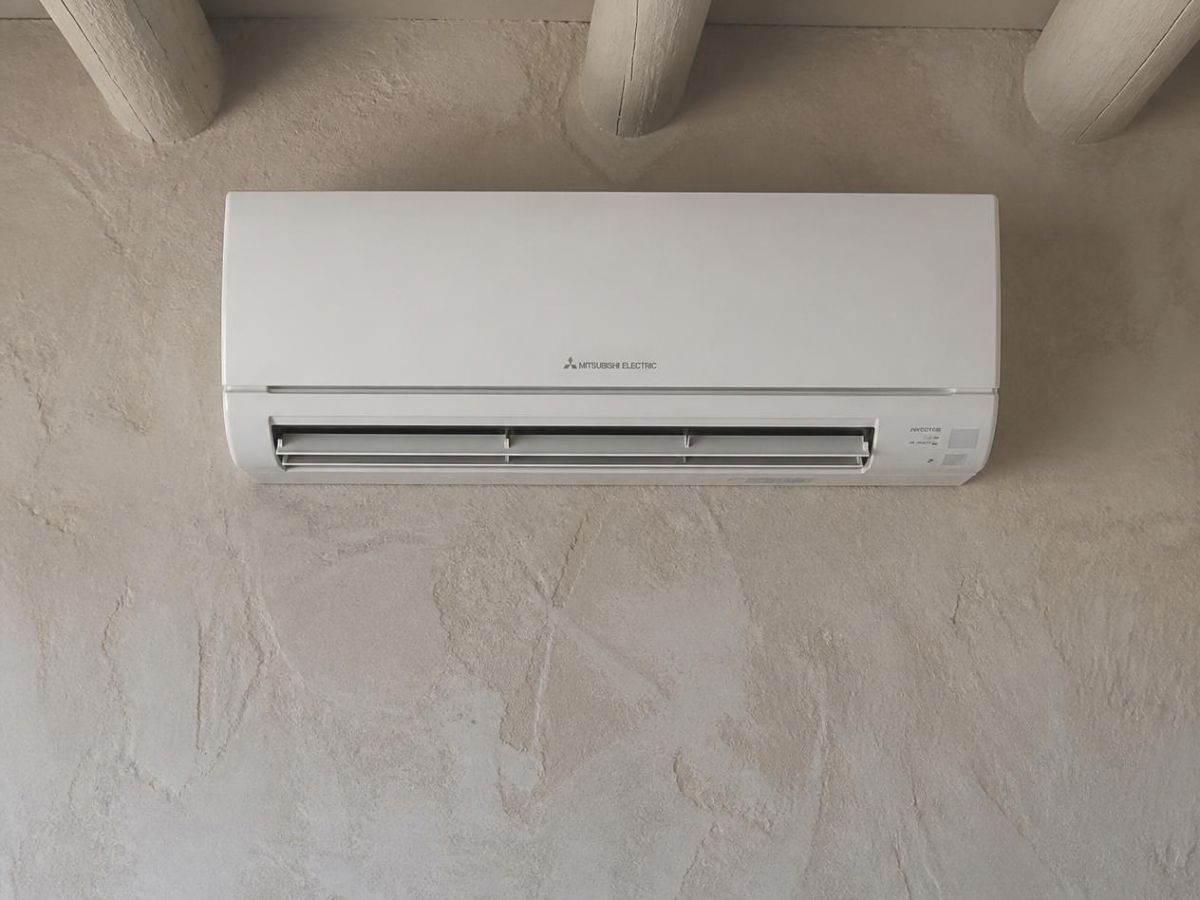
The most practical way to add air conditioning to an adobe home in Albuquerque is a ductless mini split, because it cools without any ductwork and only needs a single small opening through the wall for the refrigerant lines. That matters here, where older adobe homes in places like Old Town and the North Valley can have walls more than a foot thick that were never built to carry ducts.
Earthen walls were built in this part of the Rio Grande valley long before the Spanish arrived, and Old Town itself dates back to a Spanish settlement founded in 1706. Those old earthen homes were built for a different era of cooling, so retrofitting modern refrigerated air into them takes a system that works around the walls instead of cutting through them.
A ductless system fits that job well. It runs on the same idea as central air, moving refrigerant between an outdoor unit and one or more indoor heads, but it skips the duct network entirely. A ductless mini split puts a slim indoor head on the wall in each room you want to cool, and each head connects to an outdoor condenser through refrigerant lines. For an adobe home with no existing ducts and thick, solid walls, that avoids the biggest headache of a traditional AC retrofit, which is finding a place to route bulky ductwork through a structure that has none.
Albuquerque’s high desert setting is a big part of why this comes up so often. The city sits above 5,000 feet in dry air, which is why evaporative swamp coolers spread across town for generations. But those coolers lean on that dry air to work, and when the summer monsoon rolls in during July and the humidity climbs, they stop cooling well. Refrigerated cooling like a mini split works no matter how humid it gets outside, and it is one way to handle a swamp cooler conversion in a home with no ducts.
Do adobe houses stay cool?
Adobe houses do stay cooler than a standard frame house during the hottest part of the day, but only up to a point, and that limit is why so many owners eventually add real cooling. The reason adobe works at all is thermal mass. Those thick earthen walls absorb heat slowly through the day and release it at night, so the inside of the home lags behind the outside temperature by several hours. In a climate with big day-to-night temperature swings, that lag helps.
The trouble comes during a heat wave. Albuquerque sees only a few 100-degree days in a normal year, but when a hot stretch settles in, the walls fill up with heat and stop giving you that cool afternoon. Add monsoon humidity on top of it and the passive comfort disappears. Adobe can flatten out a normal summer day, but it cannot dehumidify, and it cannot pull the temperature down on command.
Can you drill through adobe walls to install a mini split?
Yes, you can drill through an adobe wall for a mini split, and the penetration for the refrigerant lines is usually the same standard size as any other install, close to three inches across. What changes is the depth. A standard frame wall is a single pass with a core bit, but a solid adobe or masonry wall can run well over a foot thick, sometimes closer to two feet, so an installer often drills partway from each side with an extended bit to meet in the middle.
Once the hole is through, the opening gets an insulated sleeve so moisture cannot wick into the exposed earthen material around it. Mounting hardware changes too. Adobe is a different material from drywall or brick, so the indoor head bracket needs fasteners chosen for an earthen wall, and the outdoor condenser usually sits on a stable pad on the ground. On a thick wall where a straight downhill drain slope is not possible, the install may use a small condensate pump. Done right, the whole thing leaves one clean, sealed penetration rather than the wide chases a duct system would demand.
Will a ductless air conditioner cool a whole house?
A ductless system can cool a whole adobe home, but you do it by matching indoor heads to zones rather than relying on one unit to reach every room. A single indoor head cools the room it is in, so a small home might need only one or two, while a larger or chopped-up floor plan gets several heads all fed by one outdoor condenser. That zoning is actually an advantage in an adobe house, where interior walls are often thick and rooms do not share air freely.
Because you control each zone on its own, you are not paying to cool a spare bedroom nobody uses on a July afternoon. The key is correct sizing. Each head has to be matched to the square footage and heat load of its space, since an undersized unit runs nonstop trying to keep up and an oversized one short cycles. A load calculation for the specific home, its wall thickness, and its window exposure is what tells you how many heads and what capacity you need. If your adobe home already has some ductwork, or room to add it, a ducted refrigerated air installation is also an option.
Is there an air conditioner that does not need to be vented?
Yes. A ductless mini split is the air conditioner that does not need to be vented in the way people usually mean, because it never blows exhaust out of a window or hose. Instead of moving air through a vent, it moves heat through refrigerant lines. The indoor head pulls warmth out of your room, the refrigerant carries that heat outside, and the outdoor condenser dumps it there. The only opening in your wall is that small line-set hole, not a duct or an exhaust port.
People often confuse this with a portable AC unit, which does need a vent hose running to a window and is really built for short-term, single-room use. A mini split is a permanent split system with the compressor outside, so it runs quieter, lasts far longer, and cools far more efficiently. For an adobe home where you do not want to hang a hose out a historic window or cut a big vent through a thick earthen wall, the ductless route keeps the structure intact while still giving you true refrigerated air.
Adding AC to an adobe home comes down to cooling it without cutting up walls that were never meant to hold ducts, and a ductless mini split is usually the cleanest way to do that. Tru Mechanical Heating & Cooling is a family-owned shop, licensed by New Mexico as a mechanical contractor, with more than 30 years of combined experience. We run the load calculation for your home, figure out how many indoor heads you need, and handle the drilling and sealing through thick earthen walls. To find out what your home needs, reach out to us for a free quote or service visit at (505) 328-0743.