

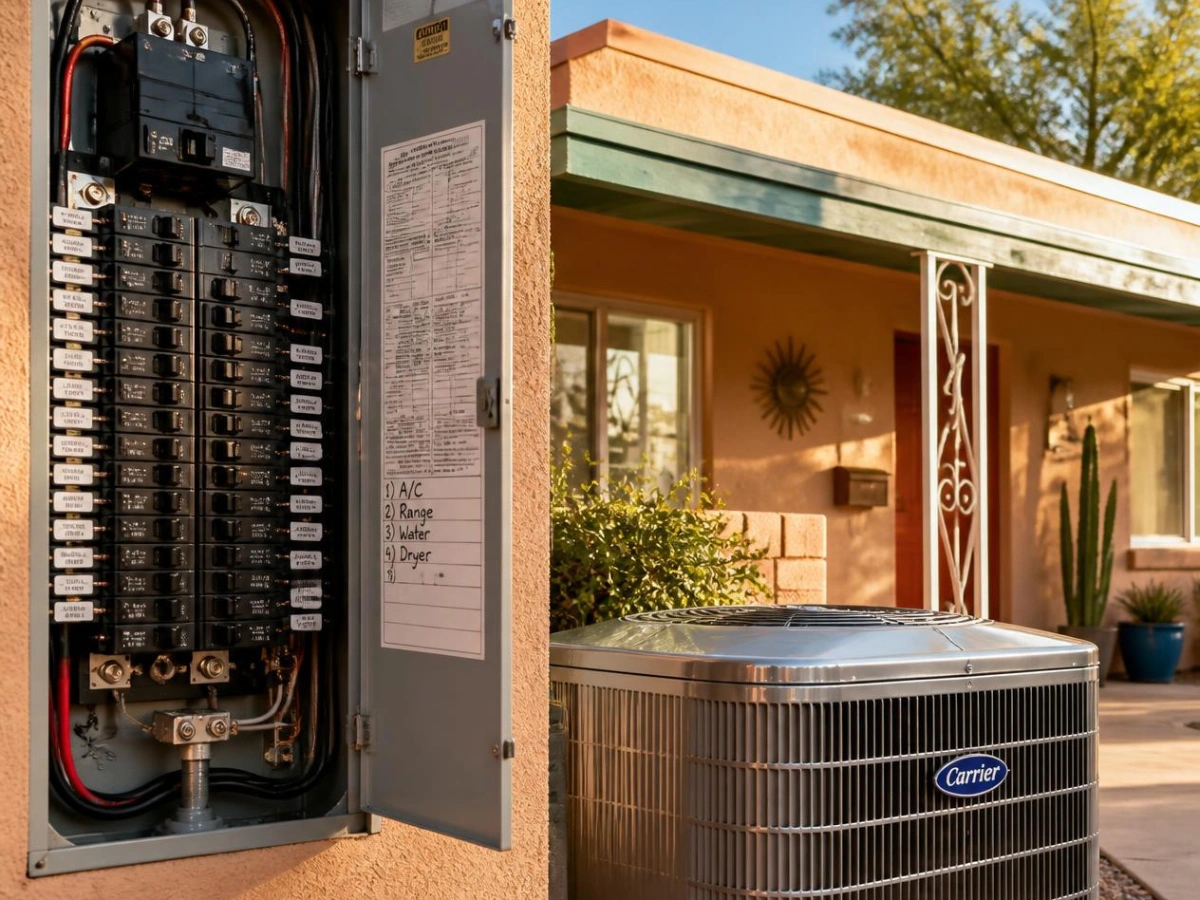
Some Albuquerque homes need an electrical panel upgrade to convert from a swamp cooler to refrigerated air, but plenty do not. It comes down to how much spare capacity your existing panel has, because a swamp cooler runs off a basic 120-volt outlet while a refrigerated air condenser needs a dedicated 240-volt circuit and a good deal more amperage. If your panel already has room, no upgrade is needed. If it is a smaller older service that is close to full, that is when a panel change enters the picture.
This trips up a lot of homeowners here. You get a conversion quote, and somewhere in the middle of it there is a line about your electrical panel that you were not expecting, and now you are wondering whether the whole project just got more complicated.
It usually has not. The panel question is common on conversions because Albuquerque has a large stock of homes built in the 1950s through the 1970s that were originally set up for evaporative cooling, and evaporative cooling barely sips power. Those homes were never wired with a big cooling load in mind. When you add a compressor that pulls real amperage, the existing service either has the headroom to carry it or it does not, and the only way to know for sure is to have someone read the panel and calculate the load.
Albuquerque’s climate is exactly why so many people are making this switch in the first place. The city sits around 5,300 feet, and the monsoon that officially runs June 15 through September 30 brings enough humidity that a swamp cooler stops keeping up right when you need it most. That combination of high-desert heat and a muggy monsoon stretch is what pushes homeowners toward a swamp cooler conversion in Albuquerque, and the electrical panel is just one of the boxes that has to be checked along the way.
How do I know if my panel can handle refrigerated air?
The clearest signal is the amperage rating stamped on your main breaker, along with how many circuits are already spoken for. Many older Albuquerque homes, especially in historic neighborhoods and established parts of town, still run on 100-amp or even 60-amp service. A 60-amp fuse box is almost always too small for a modern refrigerated air system. A 100-amp panel can sometimes handle a conversion and sometimes cannot, depending on what else is drawing power in the home.
A swamp cooler needs very little. A standard 120-volt outlet is usually enough to run one. A refrigerated air unit is a different animal, needing a 240-volt line and significantly more amperage to power the compressor and fan. To know whether your panel can carry that, a licensed pro performs a load calculation that adds up your existing demand and compares it against the panel’s rating. That number, not a guess, tells you if you have the headroom.
What is the average cost of an electrical panel upgrade?
When an upgrade is needed, a straightforward 100-amp to 200-amp change in the Albuquerque metro that keeps the panel in its current spot generally runs somewhere around $1,800 to $3,200, and that figure reflects local labor, materials, and typical permit costs. If you are replacing an older 60-amp fuse box or an unsafe panel brand with new 200-amp service, expect closer to $3,200 to $6,000, since those jobs usually involve rewiring the service entrance and bringing older grounding up to current code.
A few things push the number around here:
- Grounding and bonding. Older Albuquerque homes frequently predate modern grounding requirements, and correcting that is a small line item on its own but easy to leave out of a lowball quote.
- Panel location. A box in an easy-to-reach garage costs less to work on than one buried behind finished drywall or in a cramped closet.
- Bundling. Handling the panel as part of the conversion, in one mobilization, tends to cost less overall than scheduling it as a separate visit.
Treat these as planning ranges. The only accurate figure comes from someone reading your specific panel and service entrance.
Can I upgrade my electrical panel without rewiring my house?
Yes, in most cases. Upgrading the panel and the service capacity is a separate job from rewiring the branch circuits that run through your walls, and the two are not automatically tied together. A typical 100-amp to 200-amp upgrade swaps the panel and, when required, the meter, disconnect, and service entrance, while the existing wiring in the rest of the house stays right where it is. That is why the lower-cost upgrade assumes your current wiring and panel location can support the larger equipment without major rework.
Full rewiring only enters the conversation with the older service entrances, like a 1960s 60-amp fuse box or a known problem panel brand, where the incoming service equipment itself has to be rebuilt and grounding brought up to today’s code. For a refrigerated air conversion specifically, the electrical scope is usually narrower than that. You need a dedicated 240-volt circuit run to the new condenser and, if the panel is short on capacity, an upgrade to make room for it. That is a targeted job, not a whole-house rewire.
Who handles the electrical work during a refrigerated air conversion?
In New Mexico, panel and circuit work is performed by a licensed electrical contractor. The state requires a valid license for electrical work, and all electrical wiring requires a permit and inspection. A licensed electrical contractor is normally the one who pulls that permit. The state runs on the 2020 New Mexico Electrical Code, and in Albuquerque the local authority may add its own permit or inspection requirements on top of that.
On a refrigerated air conversion, the electrical portion is typically coordinated as part of the overall project rather than something the homeowner has to line up separately. Your HVAC contractor scopes the cooling system, ductwork, and load, and the licensed electrical work needed to support it, such as the 240-volt circuit or a panel upgrade, gets folded into the same plan and timeline. If your home also would fit a ductless mini-split system, the electrical requirements differ from central air, which is one more reason the load and panel review happens up front before any equipment is chosen.
Handling it this way keeps the sequencing clean, since the panel work, the new circuit, and the equipment install all have to happen in the right order and pass inspection.
Between the high-desert heat and the monsoon humidity that leaves a swamp cooler running warm and damp, the pressure to switch to refrigerated air in Albuquerque is real, and the panel question is just one piece of doing it right. At Tru Mechanical Heating & Cooling, our family-owned team reviews your panel and load as part of scoping the conversion, so you get a clear picture of what your home actually needs before any work starts. Call us at (505) 328-0743 for a free quote and we will walk your home, read the panel, and lay out your options.